The L293D is a versatile quad half-H driver, typically used to drive two DC motors or one stepper motor in both directions. Designed using bipolar technology, it can source or sink up to 600mA per channel (1.2A peak) and supports motor voltages up to 36V.
With built-in internal clamp diodes, TTL logic compatibility, and separate logic and motor power supplies, the L293D is ideal for compact motor control projects and is widely used in Arduino and robotics applications.
📐 Specifications:
Parameter
Value
Motor Supply Voltage (V<sub>s</sub>)
4.5V – 36V
Logic Supply Voltage (V<sub>ss</sub>)
4.5V – 7V
Output Current per Channel
600mA continuous
Peak Output Current
1.2A (non-repetitive)
Logic Input Compatibility
TTL/CMOS
Output Clamp Diodes
Internal
Control Inputs
IN1, IN2, IN3, IN4
Enable Pins
EN1 (Motor A), EN2 (Motor B)
Package Types
DIP-16 / SOIC-16
Operating Temperature
-0°C to +70°C
🌟 Key Features:
🔁 Dual H-Bridge Driver – Drives 2 DC motors or 1 stepper motor
⚡ Motor Voltage up to 36V – Suitable for a wide range of motors
💪 600mA Continuous Output Current – 1.2A peak
🛡️ Built-in Clamp Diodes – For inductive load protection
L293D 2-Channel Driver H-bridge - Raspberry Pi Pico
📄 File: l293d_2-channel_driver_h-bridge_-_arduino_uno.inoArduino Uno
867 characters
1//ekostra.com
2//electronics store in egypt
3//+201008896258
4
5// L293D: IN1=8, IN2=9, ENA(PWM speed)=10 on Arduino Uno. Motor's own power (up to several amps) comes from a separate supply into the driver board, never from the microcontroller pin.
5// L293D: IN1=8, IN2=9, ENA(PWM speed)=10 on Arduino Nano. Motor's own power (up to several amps) comes from a separate supply into the driver board, never from the microcontroller pin.
6#define IN1 8
7#define IN2 9
8#define ENA 10
9
10voidsetup() {
11Serial.begin(115200);
12pinMode(IN1, OUTPUT);
13pinMode(IN2, OUTPUT);
14pinMode(ENA, OUTPUT);
15}
16
17void driveForward(int speed) { // speed 0-255
18digitalWrite(IN1, HIGH);
19digitalWrite(IN2, LOW);
20 analogWrite(ENA, speed);
21}
22
23void driveReverse(int speed) {
24digitalWrite(IN1, LOW);
25digitalWrite(IN2, HIGH);
26 analogWrite(ENA, speed);
27}
28
29void stopMotor() {
30digitalWrite(IN1, LOW);
31digitalWrite(IN2, LOW);
32}
33
34voidloop() {
35 driveForward(200);
36delay(2000);
37 stopMotor();
38delay(500);
39 driveReverse(200);
40delay(2000);
41 stopMotor();
42delay(500);
43}
📄 File: l293d_2-channel_driver_h-bridge_-_arduino_mega.inoArduino Mega
868 characters
1//ekostra.com
2//electronics store in egypt
3//+201008896258
4
5// L293D: IN1=8, IN2=9, ENA(PWM speed)=10 on Arduino Mega. Motor's own power (up to several amps) comes from a separate supply into the driver board, never from the microcontroller pin.
5// L293D: IN1=26, IN2=27, ENA(PWM speed)=25 on ESP32. Motor's own power (up to several amps) comes from a separate supply into the driver board, never from the microcontroller pin.
5// L293D: IN1=D5, IN2=D6, ENA(PWM speed)=D7 on ESP8266. Motor's own power (up to several amps) comes from a separate supply into the driver board, never from the microcontroller pin.
5// L293D: IN1=PB0, IN2=PB1, ENA(PWM speed)=PA8 on STM32. Motor's own power (up to several amps) comes from a separate supply into the driver board, never from the microcontroller pin.
6#define IN1 PB0
7#define IN2 PB1
8#define ENA PA8
9
10voidsetup() {
11Serial.begin(115200);
12pinMode(IN1, OUTPUT);
13pinMode(IN2, OUTPUT);
14pinMode(ENA, OUTPUT);
15}
16
17void driveForward(int speed) { // speed 0-255
18digitalWrite(IN1, HIGH);
19digitalWrite(IN2, LOW);
20 analogWrite(ENA, speed);
21}
22
23void driveReverse(int speed) {
24digitalWrite(IN1, LOW);
25digitalWrite(IN2, HIGH);
26 analogWrite(ENA, speed);
27}
28
29void stopMotor() {
30digitalWrite(IN1, LOW);
31digitalWrite(IN2, LOW);
32}
33
34voidloop() {
35 driveForward(200);
36delay(2000);
37 stopMotor();
38delay(500);
39 driveReverse(200);
40delay(2000);
41 stopMotor();
42delay(500);
43}
📄 File: l293d_2-channel_driver_h-bridge_-_raspberry_pi_pico.inoRaspberry Pi Pico
877 characters
1//ekostra.com
2//electronics store in egypt
3//+201008896258
4
5// L293D: IN1=14, IN2=15, ENA(PWM speed)=16 on Raspberry Pi Pico. Motor's own power (up to several amps) comes from a separate supply into the driver board, never from the microcontroller pin.
6#define IN1 14
7#define IN2 15
8#define ENA 16
9
10voidsetup() {
11Serial.begin(115200);
12pinMode(IN1, OUTPUT);
13pinMode(IN2, OUTPUT);
14pinMode(ENA, OUTPUT);
15}
16
17void driveForward(int speed) { // speed 0-255
18digitalWrite(IN1, HIGH);
19digitalWrite(IN2, LOW);
20 analogWrite(ENA, speed);
21}
22
23void driveReverse(int speed) {
24digitalWrite(IN1, LOW);
25digitalWrite(IN2, HIGH);
26 analogWrite(ENA, speed);
27}
28
29void stopMotor() {
30digitalWrite(IN1, LOW);
31digitalWrite(IN2, LOW);
32}
33
34voidloop() {
35 driveForward(200);
36delay(2000);
37 stopMotor();
38delay(500);
39 driveReverse(200);
40delay(2000);
41 stopMotor();
42delay(500);
43}
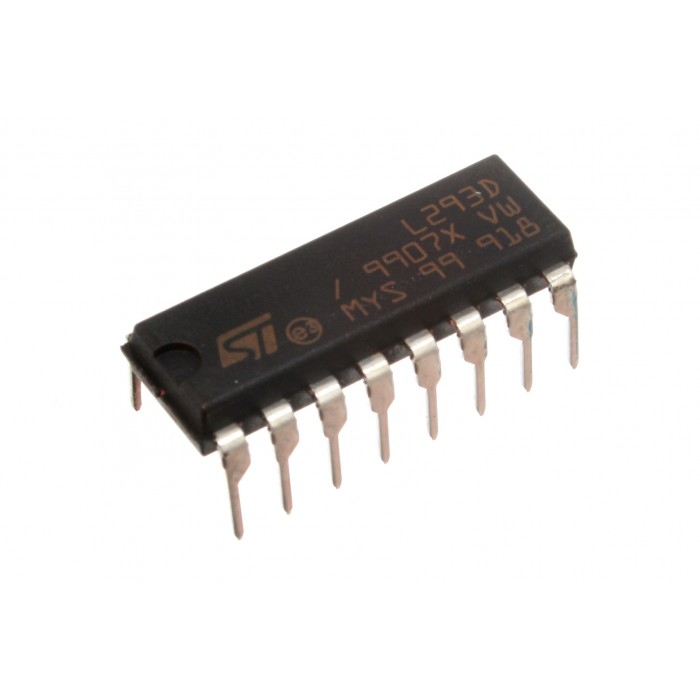
Bare L293D driver IC - same IN/EN control scheme as the breakout module.
نظرة عامة ومواصفات المنتج — بالعربية
L293D 2-Channel Driver H-bridge متوفر الآن في متجر إكوسترا للإلكترونيات، ضمن قسم Electronic Components وMotor and Display Driver ICs وMotors | Drivers وSemiconductor ICs، بسعر 35,00 EGP. كود المنتج لدينا: EK893. المنتج متوفر في المخزون وجاهز للشحن الفوري لكل محافظات مصر مع إمكانية الدفع عند الاستلام.
أهم المواصفات الفنية:
Product Name: L293D 2-Channel H-Bridge Motor Driver
Driver Type: Dual H-Bridge Motor Driver IC
Operating Voltage: 4.5V–36V DC
Output Current: 600mA per channel
Peak Output Current: 1.2A per channel
Number Of Channels: 2 (Dual Motor Control)
Logic Voltage: 5V
Control Logic: TTL Compatible
منتج أصلي بجودة مضمونة من إكوسترا، مع دعم فني ومتابعة بعد البيع لكل عملائنا في مصر.




 Specification


