


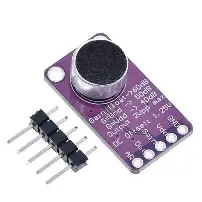
MAX9814 Microphone Amplifier Module with Auto-Gain Control for Arduino
The MAX9814 Microphone Amplifier Module with Auto-Gain Control is an advanced audio sensor designed for Arduino projects. It features an integrated electret microphone and automatic gain control, providing consistent audio signal levels across varying sound intensities. This module is perfect for applications involving sound detection, voice activation, and audio signal processing.
Features:
- Auto-Gain Control: Automatically adjusts amplification to keep audio levels stable.
- High-Sensitivity Microphone: Captures clear and accurate sound.
- Adjustable Gain: Fine-tune the gain with an onboard potentiometer.
- Analog Output: Provides a direct analog signal for easy integration with Arduino.
- Wide Voltage Range: Operates from 2.7V to 5.5V, compatible with various power sources.
- Compact Size: Small and lightweight for easy integration into projects.

Apple Shopping Event
240,00 EGP
Payment Methods:

Description
The MAX9814 Microphone Amplifier Module with Auto-Gain Control (AGC) is a popular audio amplification module for use with microcontrollers like Arduino. It’s designed to amplify audio signals from a microphone while automatically adjusting the gain to ensure consistent output levels, even when the input signal varies in volume. This feature makes it especially useful for applications where the input sound may vary, such as voice recognition, audio sensing, or other sound-related projects.
Key Features:
-
Auto-Gain Control (AGC):
- The MAX9814 automatically adjusts the microphone’s gain based on the input signal’s strength. If the sound is quiet, the amplifier boosts the signal; if the sound is loud, the amplifier reduces its gain to avoid distortion.
-
Microphone Interface:
- The module has an integrated electret microphone, which converts sound into an analog electrical signal.
-
Low Noise:
- Designed with a low-noise preamp, the module provides clean amplification of audio signals.
-
Adjustable Gain:
- Although the AGC does most of the work, there is an option to manually adjust the gain using a potentiometer if desired.
-
Output:
- The module outputs an analog signal that can be fed directly into an analog input pin on an Arduino or other microcontroller.
-
- It typically operates on a voltage range of 2.7V to 5.5V, making it compatible with most microcontrollers, including Arduino boards running on 5V or 3.3V.
Pinout and Connections:
The module typically has the following pins:
- VCC: Power supply (3.3V or 5V)
- GND: Ground
- OUT: Analog output signal (Audio output)
- GAIN: Optional pin for external gain control (some versions include a potentiometer or jumper for manual gain adjustment)
Connections to Arduino:
- VCC connects to the 5V (or 3.3V, depending on your module) pin on the Arduino.
- GND connects to the GND pin on the Arduino.
- OUT connects to one of the analog input pins on the Arduino, like A0.
Example Arduino Code:
Below is an example sketch to read the microphone signal from the MAX9814 using an Arduino and print the values to the serial monitor:
Working:
- The
analogRead()function reads the analog signal from the microphone output. The value will vary based on the sound pressure level (volume) captured by the microphone. - The Arduino can process the data from the microphone to detect sound events, measure the sound intensity, or even use it for speech recognition or sound-activated systems.
Applications:
- Sound-activated lights or devices: For example, turning on an LED or triggering an action when a certain sound level is detected.
- Voice recognition systems: Capturing audio input for voice-activated systems.
- Sound level monitoring: Detecting ambient noise levels for applications like smart homes or noise-sensitive environments.
- Audio projects: Amplifying sound for audio input in a variety of projects.
Tips:
- The output of the MAX9814 will be an analog signal, and the Arduino’s ADC (Analog-to-Digital Converter) will convert this signal into a digital value (range from 0 to 1023).
- To get the best results, keep the microphone module’s microphone within a reasonable distance from the sound source.
- Depending on your application, you might want to apply filters or smoothing techniques to the raw data to reduce noise or fluctuations in the reading.
By using the MAX9814 with AGC, you can create more consistent sound-based interactions with Arduino, even in environments with variable background noise.
نظرة عامة ومواصفات المنتج — بالعربية
MAX9814 Microphone Amplifier Module with Auto-Gain Control for Arduino متوفر الآن في متجر إكوسترا للإلكترونيات، ضمن قسم Sensors وSound Sensor، بسعر 240,00 EGP. كود المنتج لدينا: EK1565. المنتج متوفر في المخزون وجاهز للشحن الفوري لكل محافظات مصر مع إمكانية الدفع عند الاستلام.
أهم المواصفات الفنية:
- Microphone: Type: Electret condenser microphone
- Amplifier Ic: MAX9814
- جهد التشغيل: 2.7V to 5.5V DC
- Output Signal: Analog voltage (AC coupled)
- Gain Control: Auto-Gain Control (AGC): Automatically adjusts gain for consistent signal levels
- Manual Gain Adjustment: Potentiometer for fine-tuning gain
- Gain Range: Typically adjustable from 20dB to 40dB
- Frequency Response: Typically 20Hz to 20kHz
هذا المنتج مناسب لمشاريع الأردوينو (Arduino) و ESP32 و Raspberry Pi، ومشاريع الروبوتات وإنترنت الأشياء والتعليم الهندسي. جميع القطع مفحوصة قبل الشحن.
تصفّح المزيد من Sensors في إكوسترا.
Specification
 Specification
| WeightWeight | 6 g |
|---|---|
| Dimensions | 3 × 2 × 1 cm |
| microphone | Type: Electret condenser microphone |
| amplifier-ic | MAX9814 |
| operating-voltage | 2.7V to 5.5V DC |
| output-signal | Analog voltage (AC coupled) |
| gain-control | Auto-Gain Control (AGC): Automatically adjusts gain for consistent signal levels |
| manual-gain-adjustment | Potentiometer for fine-tuning gain |
| gain-range | Typically adjustable from 20dB to 40dB |
| frequency-response | Typically 20Hz to 20kHz |
| sensitivity | Provides a wide dynamic range with minimal distortion |
| output-impedance | Low impedance, compatible with standard analog inputs |
| power-consumption | Low power, suitable for battery-operated devices |
| dimensions | Generally around 22mm x 18mm |
| connector-pins | VCC: Power supply (2.7V to 5.5V) GND: Ground OUT: Analog output signal AGC: Auto-Gain Control pin (sometimes connected internally) |
| operating-temperature | Typically from -40°C to +85°C |


